
Them: "So, how long have you been here for?"
Me: "Almost four years now"
Them: "Four years!? Are you.. (whispers) illegally here?"
Courtesy of YouTube
Me: "Certainly not!I have a British Passport, thanks to Mum, who was born in Winchester, only to make her way across the seven sea's towards Australia. Twenty years later, I departed and returned to her homeland of Britain."
By arriving in this country, I have engaged one of the five -Scapes Appadurai (1990) proposed, the Ethnoscape, that is, "persons who are on the move" (Rantanen 2005, p.13). Moving to London has allowed me to engage more with a globalised world, which in turn, is one of the most positive experiences of my life
When I first arrived, I had no smartphone or laptop. There was no 'Viber' or 'Skype' for phones, and no iMessage or BBM. Long distance calls were expensive and my parents couldn't understand the effort involved in buying a calling card, standing in a red phone booth and speaking to the other side of the world.

Courtesy of Squidoo
To their relief when technology advanced, including more public WiFi, as well as Apps such as Viber and Skype on phones, so did our relationship. Those distances between us became shorter, and we embraced Appadurai's (1990) Technoscapes, allowing us to communicate "at high speeds across various kinds of previously impervious boundaries" (Rantanen 2005, p.13).
Courtesy of the Guardian
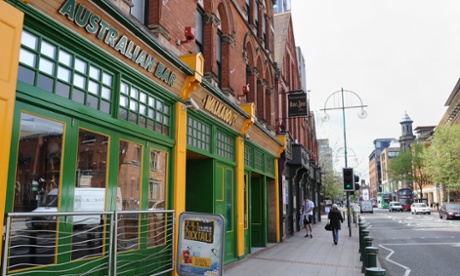
While I have embraced an English existence and become a "globalised Australian" (Guardian, 2013), I love a Sunday roast, use the word "bollocks" and just LOVE to talk about the weather, other Australian's have created diasporic communities; we have 'Walk Abouts', amateur AFL teams and shops selling Australian products (thank God!).
Thanks to Globalisation, we have created, a mini-Australia and furthered the footprint of our global flows and scapes, becoming what Appadurai calls 'deterritorialized' (cited in Rockefeller 2011, p. 560) and "no longer produced in relatively contained places but rather are made and experienced translocally, often in locales across the globe" (Rockefeller 2011, p. 560), and I, Sir, am glad to be apart of it.
Delaney, B 2013, 'The Walkabout: Australian home from home or national embarrassment?', Guardian, 13 June, retrieved 29 July 2013, http://www.guardian.co.uk/lifeandstyle/2013/june/13/australia-cricket-walkabout-themed-pub
Rantanen, T 2005, 'Theorizing media globalization', The media and globalization, Sage, London
Rockefeller, S 2011, "Flow", Current Anthropology, vol. 52, no. 4, pp. 557-578

Firstly, the imagery on your blog makes it so much more appealing to read! Secondly, you’re blog is a really captivating, easy flowing piece of writing. I really enjoy when personal stories are intertwined with the point of the writing. You’re use of personal evidence which is connected to ‘ethnoscapes’ made the blog have a really researched feel. The examples of technological advances such as Wifi and Skype and linking them to how you communicated with your parents who are overseas definitely shows that globalisation has increased connectivity.
ReplyDeleteThis comment has been removed by the author.
ReplyDeleteHey Ashleigh, I enjoyed reading this post, it was a great mix between personal anecdotes and referenced material. It was an easy read and flowed nicely from each point and example to the next. Using your personal experiences to explain Appandurai’s concept of enthoscape has turned something that could be a complex concept in to something that is really easy to understand and relate to. The photos and YouTube clip were great to…the guinnie pig, priceless!
ReplyDeleteYour use of personal experiences also emphasise how much globalisation has changed in such a short time. Your post sums up globalisation and the global scapes nicely.
Have to agree with Jaime here, loved the fact that you included so much imagery to help spur the piece along! Really enjoyed this post as a whole, it included both the scholarly references that help back up your point, and also a progressional anecdote describing your personal life, which helps us be able to really picture the information being fed to us by giving us personal merit.
ReplyDeleteThe layout of the entire blog flowed really well, and at no point did it feel like it dragged on, I was happy to read the entire thing.
Being able to personally tell us about the globalisation between Australia and England, with the amateur AFL league and such was a really interesting point to bring up, seeing as we get the flip side of it across the pond.
Ashleigh, I enjoyed the way you began your post with the light-hearted scenario questioning the legitimacy of your residency in England. This humour is incorporated throughout the piece, allowing it to flow nicely from point to point, yet you never stray from the topic which is a common mistake. The way you use yourself as an example of global flows and scapes enticed me to read on, and seemed to effortlessly link this to the course content. This indicates a clear understanding of the topic and you use relevant scholarly sources to effectively support your main ideas. Using a few links to emphasise globalisation's effect on the two countries may have helped, but overall a cleverly written piece.
ReplyDeleteAshleigh,
ReplyDeleteI love the title of this blog. Very witty and it drew me in automatically to the tone that this piece was going to be: Very comical.
Your ability to link your personal experience to the workings of theorists has a great fluidity, and allows the reader to really grasp the concepts you are bringing forward whilst also showing your understanding of the topic extremely well. Also, although it doesn't feel like a scholarly read it uses a lot of resources in order to bring your argument credibility, well done.
The use of images allowed for a comparison between England without the technological advances and a more globalized England. But just remember to reference the images and video within the reference list, just to avoid mark downs. Overall, a very great post. Very much enjoyed reading this.
That was funny :)
ReplyDeleteCongratulations on managing to intertwine a well-supported post with humour and insightful views on how you perceive Appadurai's theoretical concept of ethnoscape to apply to your personal experience. I do relate to your examples as I've experienced similar situations (phone cards, difficulties in sharing what it means to be 'delocalised' to those who have never travelled...) and though the first video and image you used could be seen as caricatures, they actually manage to express the feelings one might experience in the situations you described. You've got a keen eye for those 'special' moments and you've supported your views with relevant quotes and references. It was a pleasure to read your post, thanks.