
Them: "So, how long have you been here for?"
Me: "Almost four years now"
Them: "Four years!? Are you.. (whispers) illegally here?"
Courtesy of YouTube
Me: "Certainly not!I have a British Passport, thanks to Mum, who was born in Winchester, only to make her way across the seven sea's towards Australia. Twenty years later, I departed and returned to her homeland of Britain."
By arriving in this country, I have engaged one of the five -Scapes Appadurai (1990) proposed, the Ethnoscape, that is, "persons who are on the move" (Rantanen 2005, p.13). Moving to London has allowed me to engage more with a globalised world, which in turn, is one of the most positive experiences of my life
When I first arrived, I had no smartphone or laptop. There was no 'Viber' or 'Skype' for phones, and no iMessage or BBM. Long distance calls were expensive and my parents couldn't understand the effort involved in buying a calling card, standing in a red phone booth and speaking to the other side of the world.

Courtesy of Squidoo
To their relief when technology advanced, including more public WiFi, as well as Apps such as Viber and Skype on phones, so did our relationship. Those distances between us became shorter, and we embraced Appadurai's (1990) Technoscapes, allowing us to communicate "at high speeds across various kinds of previously impervious boundaries" (Rantanen 2005, p.13).
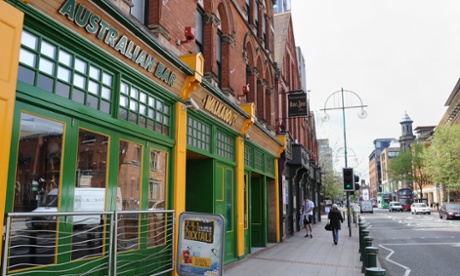
Courtesy of the Guardian
While I have embraced an English existence and become a "globalised Australian" (Guardian, 2013), I love a Sunday roast, use the word "bollocks" and just LOVE to talk about the weather, other Australian's have created diasporic communities; we have 'Walk Abouts', amateur AFL teams and shops selling Australian products (thank God!).
Thanks to Globalisation, we have created, a mini-Australia and furthered the footprint of our global flows and scapes, becoming what Appadurai calls 'deterritorialized' (cited in Rockefeller 2011, p. 560) and "no longer produced in relatively contained places but rather are made and experienced translocally, often in locales across the globe" (Rockefeller 2011, p. 560), and I, Sir, am glad to be apart of it.
Delaney, B 2013, 'The Walkabout: Australian home from home or national embarrassment?', Guardian, 13 June, retrieved 29 July 2013, http://www.guardian.co.uk/lifeandstyle/2013/june/13/australia-cricket-walkabout-themed-pub
Rantanen, T 2005, 'Theorizing media globalization', The media and globalization, Sage, London
Rockefeller, S 2011, "Flow", Current Anthropology, vol. 52, no. 4, pp. 557-578
